By Derwin L. Montgomery
WS Chronicle
A lunch conversation at West End Cafe became more than a meeting.It became a relationship.It became a lesson in local history.
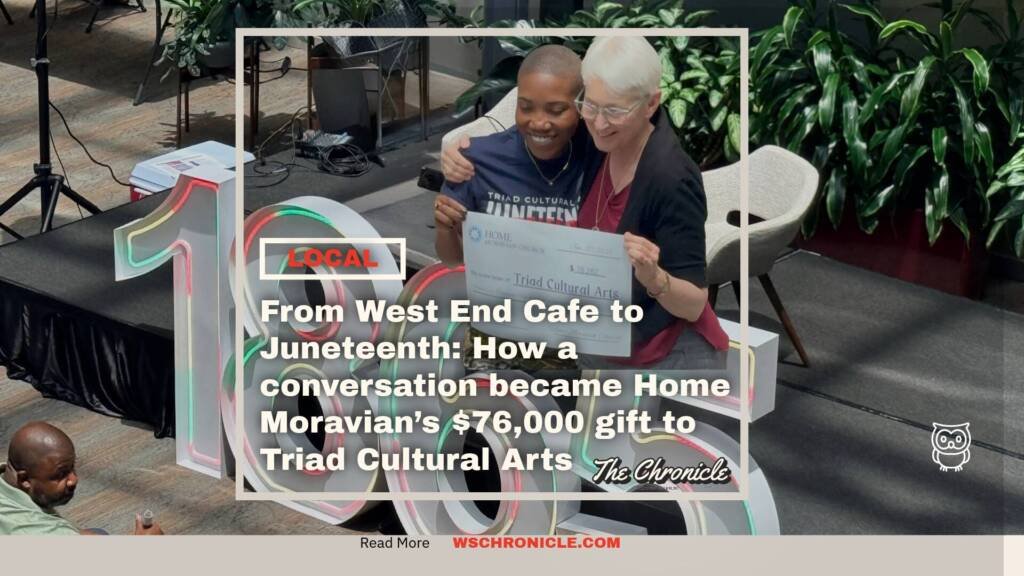
And by Juneteenth, it became a $76,262 gift from members of Home Moravian Church to Triad Cultural Arts — enough to help the organization pay off a $75,000 bridge loan connected to the restoration of the historic Shotgun House Legacy Site in Happy Hill.
For Triad Cultural Arts Executive Director Abrea Armstrong and the Rev. Ginny Hege Tobiassen, pastor of Home Moravian Church, the gift represents something larger than a financial transaction. It is part of a growing effort among local Moravians to put faith into practice by confronting history, supporting neighbors and investing in work that helps repair long-standing inequities in Winston-Salem.
Home Moravian’s weekly newsletter said more than 80 church members contributed to the Shotgun House effort, allowing Triad Cultural Arts to pay off the loan from the Winston-Salem Foundation. The church said the gift grew out of its role as an “active ambassador” for the project and its desire to continue a relationship with a neighborhood whose history is “so entwined with Salem’s own.”
The relationship began after the Rev. Russ May helped connect Armstrong, Triad Cultural Arts founder Cheryl Harry and Tobiassen. Armstrong said May had become aware of the bridge loan Triad Cultural Arts had taken out to help complete restoration work on the Shotgun House. He helped bring the leaders together over lunch.
From that table, the partnership began to take shape.
Tobiassen said the conversation helped lift up a history that has long connected Salem and Happy Hill — two communities separated by distance, race and power, but bound together in Winston-Salem’s story.
“It was important to me to recognize the connection between the Salem community and the Happy Hill community,” Tobiassen said. “There’s a long history there.”
That history, she said, includes the period after emancipation when free Black residents sought to buy lots in Salem. According to Tobiassen, Salem trustees first considered selling those lots but faced resistance from residents. Instead, land was made available farther out, on the former Schumann plantation land, in what became Happy Hill.
“So as a matter of saying yes and no at the same time, I think that’s a history we have to sort out,” Tobiassen said. “But our congregation is eager to learn more and to understand how the history of Happy Hill relates to the history of Salem, and that we need to lift each other up.”
That willingness to learn was key to the gift. Tobiassen said she brought the idea to Home Moravian’s board of elders and board of trustees. At a joint board retreat, members took tours provided by Triad Cultural Arts about African American history in Winston-Salem. She also shared information from church records that showed the connection between Salem and the beginnings of Happy Hill.
“Once the information was presented to the congregation, I’d say they were all in,” Tobiassen said. “Very excited about building that relationship.”
Triad Cultural Arts has been doing that kind of educational work for years. Founded in 2007, the nonprofit describes itself as a community-based, multi-disciplinary cultural arts organization dedicated to preserving, interpreting and commemorating the heritage of Black Americans through festivals, heritage tours and arts programming. The organization says its larger mission is to help build a culturally competent community where diversity is respected and social change is possible.
Its signature work includes the annual Juneteenth Festival, Black heritage tours, exhibits, lectures and cultural programming. The Winston-Salem Foundation has described Triad Cultural Arts as a driving force in preserving and celebrating African American heritage in the area, noting that its Juneteenth Festival draws more than 10,000 attendees annually.
The Shotgun House Legacy Site has become one of the organization’s most visible projects. Located in Happy Hill, the site is designed to preserve and interpret the story of Winston-Salem’s first planned African American community. Triad Cultural Arts says the project is intended to lift Happy Hill’s history “out of obscurity” and repurpose the shotgun house for education, African American history and cultural programming for generations to come.
The larger vision is not simply to save a building. The Shotgun House Legacy Site is designed to illuminate the local Black experience and show how Happy Hill and Winston-Salem fit within the national story. Plans for the site include restored interiors, oral histories, artifacts, photographs, videos, exhibits, panels, outdoor interpretation and interactive programming.
For Armstrong, that is why Home Moravian’s gift matters so much. It helps relieve pressure on an organization working to preserve Black history while also trying to build long-term stability.
She said capital projects, operations and capacity-building support are often among the hardest dollars for Black-led nonprofits to secure. Paying off the loan means unrestricted funds can support the organization’s future instead of going toward debt.
“To be able to free up $75,000 of unrestricted funds to support that, and not have it go toward the loan, is super meaningful,” Armstrong said. “It means not having to worry about survival in that way.”
The Winston-Salem Foundation announced the $75,000 bridge loan in November 2024, saying the investment would support restoration of the historic shotgun house and help move the multi-phase legacy site toward completion. The foundation said Triad Cultural Arts planned to reimagine the shotgun house as a museum and exhibit space honoring African American culture in Winston-Salem.
The timing of Home Moravian’s gift also carried historical weight. The check was presented during Winston-Salem’s Juneteenth celebration, connecting the gift to the city’s broader freedom story.
“When I think about our freedom story here in Winston-Salem, and how St. Philips is where it was announced that emancipation was indeed real, and this idea of St. Philips’ connection to Home Church, and how emancipation was a spark of Happy Hill, which is why the Shotgun House is here — all of those moments and historical context are traces of the ancestors,” Armstrong said.
She called the Juneteenth presentation a “synergistic moment” that gave Triad Cultural Arts a sense of freedom and stability.
The gift also fits within a broader pattern of Moravian congregations and leaders taking on community needs in practical ways.
Tobiassen was careful to note that Home Moravian is not the only Moravian congregation engaged in this kind of work. Trinity Moravian Church has drawn local and national attention for its Debt Jubilee Project, which buys and forgives medical debt for families. According to Trinity Moravian, its first campaign wiped out more than $1.3 million in debt for more than 1,000 area households, and its second campaign erased $3.3 million in medical debt in Davidson and Davie counties. By the beginning of 2024, the church said the project had bought and forgiven more than $14.6 million in medical debt for more than 10,000 North Carolina households.
The effort has continued. WFDD reported in 2025 that Trinity Moravian raised more than $25,000 in a winter campaign to forgive about $2.5 million in medical debt for families in Central North Carolina.
Moravian leaders have also become involved in affordable housing. The Moravian Church Southern Province has helped lead the Equitable Homeownership Project, a collaborative effort aimed at building affordable homes for first-time buyers in Winston-Salem. The project began with four homes in the Southwest Ward after the church initially proposed building on 19 city-owned lots.
The Chronicle previously reported that the Equitable Homeownership Project was born in part out of conversations about the Moravian Church’s role in the creation of marginalized communities in Winston-Salem and a desire to help close the homeownership and generational wealth gap. The project targets households earning less than 80% of area median income and brings together partners in construction, real estate, lending and homebuyer support.
For Tobiassen, this is what faith is supposed to look like.
“In the Moravian Church, being part of the community, building community, taking care of neighbors, is very important to who we are,” she said. “We’re a church that’s really grounded in intentional community.”
She said Moravians often emphasize how people live out their beliefs, not simply what they say they believe.
“In the Moravian Church, we always say it’s more about right practice than it is about right doctrine,” Tobiassen said. “Not about what you write down that you believe, but how you act out what you believe.”
Armstrong said Home Moravian’s involvement has already moved beyond giving. Several members have signed up to become Shotgun House ambassadors. She hopes members will continue serving as volunteers, tour guides, garden helpers, board members and advocates for the site.
“It’s not even about what I see,” Armstrong said. “That’s how they see it. They’re like, ‘No, we don’t want this to be the end.’”
That is what makes the West End Cafe conversation significant. What began as lunch became a relationship. What began as a relationship became a gift. And what began as a gift may become a model for how Winston-Salem tells the truth about its history while building something more honest across communities.
Tobiassen said she is grateful for the opportunity and eager for the relationship to continue.
Armstrong said she hopes the broader community will see the Shotgun House as more than a Black history project. It is a Winston-Salem history project.
And now, because of a conversation, a congregation and a willingness to act, Triad Cultural Arts can move forward with one less financial burden and a wider circle of partners committed to helping the story live.